
Our February Newsletter is now online!
 Detroit Greenways Coalition
Our February Newsletter is now online!


We have a fundraiser on Facebook. Facebook is matching the first $7 million in all donations starting on #GivingTuesday at 8 AM.
If you prefer, you can setup your own Facebook fundraiser with the Detroit Greenways Coalition as the beneficially.
We also have a donation page on our website with payments handled securely through PayPal. There’s the option for regular monthly or annual donations as well.
There is no better time to make Detroit a more walkable and more bikeable city. We’ve seen COVID-19 affect our family, friends, and communities. We’ve been unable to do many things we enjoy doing while experiencing the added stress of social distancing.
As a result, many of us have been spending more time outside, at the parks and trails, on our bikes, in our kayaks, running, or walking. It’s helping keep us physically, mentally, and socially healthy, while strenghening our resistance to potential illness. For many it’s also providing an alternative safe travel option with good social distancing.
Others are discovering these outdoor options as well. We’ve seen trail usage increase by over 40% on the Dequindre Cut this year. We’ve also see a growing momentum to make Detroit a more convenient, safe, and fun place to walk and bike — a place with more trails, more Complete Streets (e.g. better sidewalks, bike lanes, speed humps), and more greenspace.
Your donation will help keep pushing this vision forward, not only for us, but for many who will benefit from a safer and healthier city yet are unable to contribute. Your support will enable us to continue our advocacy and technical assistance citywide as we have since 2007.
There an added incentive for donating this year. Under the CARES Act, individual taxpayers can deduct up to $300 in cash donations — even when taking the standard deduction.
We appreciate any and all support.
Stay Healthy,

Todd Scott, Executive Director
 There is an opportunity for major improvements to Michigan Avenue’s design through Corktown so mark your calendar for Tuesday, December 2nd at 6pm. MDOT is hosting a virtual public meeting to collect your input. (Meeting details) They need your input!
We’ve come quite a ways from ten years ago when we first asked MDOT to add regular bike lanes to this state trunkline. It was met with a great deal of resistance from both legal and engineering standpoints. We continued to push, find answers to the issues, and was eventually successful. Later those became protected bike lanes.
Now we can push this design forward into something much better, e.g. raised or sidewalk-level bike lanes with curb protection, protected intersections, wider sidewalks, and green stormwater infrastructure. One priority we already shared with MDOT is the need for a maintenance plan. We want a great design that’s also free of debris.
This isn’t just a planning exercise. $20 million in construction funding has been allocated for 2022.
Happening in parallel is the MDOT Connected and Automated Vehicles (CAV) Corridor project along Michigan Avenue and I-94 between Detroit and Ann Arbor. They are looking to design “an innovative infrastructure solution that allows for a mix of connected and autonomous vehicles, traditional transit vehicles, shared mobility, and freight and personal vehicles.” We’re on the project’s stakeholder group and really want to ensure that shiny new transportation concepts don’t interfere with the tried-and-true mobility provided by biking and walking. We’re optimistic given that Mark de la Vergne, Detroit’s former Cheif of Mobility Innovation is now leading this project for the contractor, Cavanue.
Of course Ford’s Michigan Central project is along this section of Michigan Avenue. They recently held a public meeting to share more of their vision for the former train station, surrounding campus, and May Creek Greenway. There’s additional information in this Detroit News article, Ford unveils Michigan Central site plan for Corktown.
 The good news? The Strand pavement near the Coast Guard station has been replaced. The bad news? The last we checked, some sections of the bike lane are in really poor condition here. Still, you should be able to get around them.
Other updates include the reconfiguration of Central Avenue on the eastern portion of the island. It’s now marked for eastbound vehicle travel only with a two-way shared-use pathway. We would have preferred seeing vehicles prohibited altogether from this roadway, but this is an improvement — and the surface has been repaved.
Phase 1 of the new Iron Belle Trail is also under construction from the beach to the Boat Club. This will be a much welcomed trail for all but the faster, fitness-oriented bicyclists who will prefer staying on the road. The DNR also recommended $1.35 million in Land Water and Conservation Funds (LWCF) to build Phase 2 of this trail which will eventually extend this trail around the island.
We are continuing to advocate for safer bike lane designs on the island, but especially for the MacArthur Bridge. Unfortunately we do not have any updates at this time.
 The grand opening of the new Fort Street Bridge Park was at the end of October. This park gives recognition to the Ford Hunger March of 1932 with a monument constructed from parts of the original historic bridge. There are additional bridge parts remaining and we’re trying to see if they can be used for a gateway monument to welcome bicyclists and pedestrians entering Detroit via the Gordie Howe International Bridge.
Huron-Clinton Metroparks to establish Detroit presence through agreement with Detroit Riverfront Conservancy, Crain’s Detroit Business.
Drivers let their focus slip as they get used to partial automation, Insurance Institute for Highway Safety.
Piloting wayfinding to connect community to resource centers in Detroit, Smart Growth America.

Last month we helped support Council members Scott Benson and Roy McCalister Jr. as they hosted three casual bike tours. The purpose of the rides was “to demonstrate to council members, other elected officials, and the city’s, and region’s transportation decision makers how bicycle lanes keep Detroiters safe.” These tours were also an opportunity to talk about traffic calming in the neighborhoods and green stormwater infrastructure (GSI).
The rides began in Detroit’s Avenue of Fashion on Livernois, traveled north through Ferndale, Pleasant Ridge and back to Detroit. A highlight was having Ferndale Mayor Melanie Piana talk about how the bike lanes have helped attract new business to Livernois while providing a safe family-friendly travel option for residents to get those businesses.
Other highlights:
More information on these tours (and more photos) are on our website and on Fox 2 Detroit.

Speaking of Wayne County, they are also working to extend the Rouge River Gateway Greenway. That trail currently connects Hines Drive to Michigan Avenue (near Andiamo’s). The long term plan is to extend that trail to the Detroit River. A new trail segment behind Greenfield Village is being designed now.
How can you get involved? They have a short survey online to collect input on your trail use. There’s also a virtual community meeting planned for September 16th at 6pm. Information on how to join the meeting will be posted on the website prior to the 16th.
Meanwhile over in Rouge Park, the City of Detroit has added a two-way cycletrack along Spinozza Drive. They’ve also created this video to explain how it works. The design is very similar to the cycletrack in Palmer Park — which has apparently reduced speeding traffic. Vehicles used to regularly crash into the lightposts along this stretch of road, but none have done so since the cycletrack was installed.
Also along the Rouge River, trail design work is underway at Rogell Park. The first community meeting is scheduled for September 23rd at 6:30pm. Watch for more forthcoming details on our Facebook and Twitter feeds.

All three of these issues are ongoing. This is what we know currently, so stay tuned for future updates.
 We are also a member of the Vote Yes for MI Water, Wildlife & Parks Coalition. Together we are supporting a November ballot proposal that ensures continued grant funding from the MNRTF and strikes a better balance between funding development and acquisition projects. Currently 75% of the grant funding is only for land acquisition (which Detroit typically doesn’t need to do.) If the proposal passes, a minimum of 25% would go towards acquisition and a minimum of 25% for development.
  A new warehouse could replace the former Cadillac Stamping Plant along the Conner Creek Greenway/Iron Belle Trail, just south of the Coleman A. Young Municipal Airport. We’re involved because we don’t want truck traffic negatively impacting the trail. We also see this as an opportunity to replace an unused parking lot (circled in red) along the greenway with GSI and green buffering. While greenways are often viewed from a recreational standpoint, this trail could be a great option for local employees who chose to bike or walk to work.

The City of Detroit announced the Phase 1 construction of the Joe Louis Greenway. This will mostly be on 3-mile section of the former Conrail property between Warren and Fullerton Avenues. Construction is expect to begin in the spring of 2021. The City adds, “Phase 1 will include separate paths for slow and fast users (such as walkers and cyclists) and will provide safe street crossings and neighborhood connections.” Awesome!
For those disappointed that only 3 miles are being built should remember that Phase 1 of the Dequindre Cut was less than a mile. Greenways that require environmental cleanup and are more than just a strip of asphalt or gravel are expensive. This is a fairly good start that will build momentum for further investment.
In the meantime, the City is asking everyone to take this very interesting survey to gather your thoughts and expected uses. The survey will close on August 21st.
The City is hosting an online public meeting on August 13th at 6pm. This meeting is primarily focused on residents in the 48210, 48238, and 48204 ZIP codes as well as Dearborn residents. The City “heard loud and clear” during the Framework meetings that local residents wanted a lead voice in the greenway’s design through their community.
 For more than a decade, we’ve highlighted our concerns about MDOT’s I-94 project through Detroit. When the City and other stakeholders joined in, MDOT listened. They’ve made nearly all of the changes we’d asked for, including fewer service drives, more connections over the freeway, and improved pedestrian crossings. Those changes were just approved by the Federal Highway Administration and are posted online.
MDOT is hosting two online public meetings on August 13th at 9:30AM and 5:30PM to discuss this milestone and provide additional information.
 As part of the project, MDOT has already removed the Second Avenue bridge over I-94. The new bridge should be open by the fall of 2021. The Cass Bridge will be replaced starting next year. While the Third Avenue bridge was to be removed next year (and not replaced), MDOT is now looking at repurposing this bridge to maintain access in the near term.
The changes to the I-94 project also include a fully separated trail bridge for the Conner Creek Greenway and Iron Belle Trail. This bridge connects to the existing trail north of Harper Avenue as well as the new Chandler Park trail at Shoemaker. The path will continue south as a two-way cycletrack on Conner Avenue to E. Jefferson.
We brought forward many issues relating to the FCA Expansion and how it affected the Conner Creek Greenway. The Greenway was routed on portions of St. Jean which no longer exist. We were concerned the Conner Avenue bike lanes might go away as well. That is not the case as the State of Michigan recently awarded road funding to improve Conner Avenue near the plant and shift the bike lanes to the eastside of the road.
“FCA appreciates the coordination of efforts between the City of Detroit and MDOT to secure funding for local road improvements that will support the addition of 5,000 new jobs at our Mack and Jefferson North Assembly plants,” said Marc Brazeau, head of Logistics – North America, Fiat Chrysler Automobiles. “We are equally pleased that these improvements will benefit local residents and businesses, as accommodations will be made for bicyclists and pedestrian access to local core services and recreational facilities.”

 The Detroit Department of Public Works (DPW) has been continuing their Complete Streets projects, working on a transportation master plan called “Streets for People”, and responding to the COVID pandemic. Caitlin Malloy-Marcon, Deputy Director of Complete Streets recently presented updates during a recent Green Task Force Transportation and Mobility committee.
The Complete Streets projects will mostly be completed this year. This includes Grand River (and the Grand Parklet), Livernois, Riopelle (in Eastern Market), Jos Campau, Conant, Kercheval, W. McNichols, and Rosa Parks (from W. Grand Boulevard to Clairmont). East and West Warren are slated for 2021, but require additional community engagement.
Complete Streets are more important than ever. With fewer vehicles on the roads, increased speeding has been reported. Detroit residents also continue to request speed humps to reduce speeding in residential areas. There are now 6,000 speed hump requests in the queue. This is far more than the city has funding for so they are prioritizing locations near schools and parks.
The “Streets for People” planning is underway though they are largely doing data collection at this time while trying to determine how to best enage the public during the pandemic. They have found that 40% of all reported collisions occur on just 3% of city streets. They have also developed educational materials. We’ll certainly share more information about this project as it progresses.

Lastly, DPW has been responding to the pandemic by making it easier for businesses to offer outdoor dining within public right-of-ways, i.e. sidewalks, alleys, and roads. They’ve streamlined the permitting processes, and where requested, closed some roads to vehicle traffic. It’s been a “great success” though most of the requests have been in the downtown area. They are also looking to pursue similar efforts that would open right-of-ways for outdoor retail as well as recreation near schools, especially since some gyms may be repurposed as classrooms.
 Amazon and FedEx want automated delivery devices as a last-mile solution for delivering packages. They have been working with legislators to change state law and allow autonomous half-ton, motorized vehicles on all Michigan sidewalks operating at 10 MPH — and grant them all the rights pedestrians.
What could possibly go wrong?
From the start, we’ve been leading on this issue, creating an analysis of how other states regulate these, and highlighting issues with the proposed language. We’ve focused on protecting existing pedestrian access (including those with disabilities), while keeping them out of bike lanes and trails. Perhaps most importantly, we’ve asked for local control so cities like Detroit have the flexibility to manage these new devices and preserve a walkable environment. Council member Scott Benson introduced a resolution (later passed by Council) that also asked for local control.
The legislation (SB 892) passed out of committee with Senator Adam Hollier (D-Detroit) opposed. It did include some of what we asked for, including a prohibition on trails. It doesn’t specifically allow them in bike lanes. The local control is extremely limited. It also allows any individual to operate these devices and for reasons other than delivery. On a positive note, it does include improved pedestrian crosswalk provisions which we strongly support.
We’ll continue working with others, including the Michigan Municipal League and Detroit City Council to try influencing legislators to pass a bill that doesn’t prioritize the delivery business over walkability.

 Staying Healthy, Events Cancelled
We hope everyone is staying safe and healthy during these challenging times. Our thoughts go out all that have lost friends, family, and club members during this pandemic.
We have been updating our COVID-19 page based on information from federal, state and local government agencies. They advise everyone riding, walking, and running to social distance from others, and to wear a mask in places that make social distancing difficult to maintain, eg. RiverWalk.
There are reports of more motorists speeding given fewer motor vehicles on the roads. Please be extra vigilant and walk/ride/run defensively.
As for events, we obviously could not hold Bike to Work Day this year. We may consider doing something this fall, but it’s too early to make any commitment. We have cancelled our Joe Louis Greenway fundraiser ride scheduled for next month.
The Stay-at-Home order has provided a good opportunity to completely overhaul our website, which we rolled out this week. All of the web pages have been brought up to date. We’ve also taken the information from our printed bike/trail map and safety brochure and put it on the site. This includes

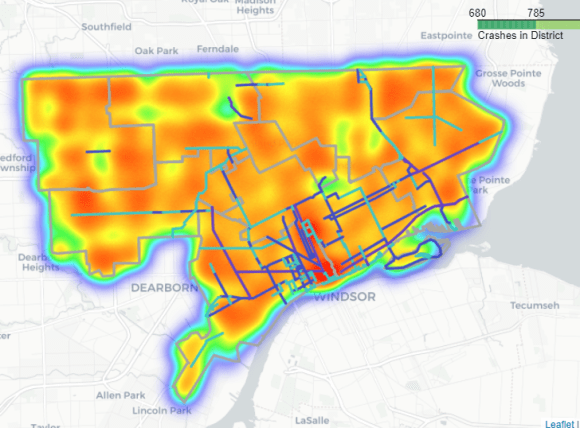
Also on the new website is a bicycle and pedestrian crash analysis — a report, slidedeck, and interactive mapping. This was just produced by a team from the University of Michigan School of Information. The team took state crash data, cleaned it up, and analyzed where the crashes were occuring. From the report:
Our data analysis led important discoveries around the existing safety issues per counsel district, specifically, how bikers are currently being impacted with districts. District 4, according to the data, had the most instances of biker injuries. It’s also worth noting that when a bike lane is present, accidents happen at a frequency a fraction of the time compared to instances of no bike lane with the point of contact being in the roadway.
Thanks to the team for this project and we look using this data to justify great investments that make Detroit streets safer for everyone.


MDOT is reconstructing nearly seven miles of I-94 through the heart of Detroit. The original approved design in 2004 removed many bridges that bicyclists and pedestrians rely on. It also called for new service drives to be added, widening the freeway’s footprint and making the urban environment less walkable and bikeable. The impacts were alarming.
Fortunately there are new design changes being proposed that address these issues — changes that have been supported by the City of Detroit, Detroit Greenways Coalition, and others.
Those changes are in MDOT’s recently released Draft Supplemental Environmental Impact Statement (DSEIS) for the I-94 project.
This DSEIS looks at:
The DSEIS did not reevaluate the need for two additional freeway lanes.
Public comments on these design modifications can be submitted through October 28th. MDOT is hosting two public meetings on October 10th in Midtown and on the Eastside. The email address for comments is MDOT-I94comments@michigan.gov.

What we like:
What we don’t like:
One area we want to further review is green stormwater management. It is mentioned, but it appears less specific than we would prefer. What’s quite specific is this project increase impervious surface area by 78.55 acres.
It’s also unclear how the new Harper Avenue extension would cross the proposed Joe Louis Greenway routing near the existing rail line west of St. Aubin. (The plan references the previous Greenway routing on St. Aubin.)
While not related to our work, it’s worth noting that the new plan saves the United Sound Systems building by moving it one parcel north.