Categories
Greenways Policy

Why We Endorse Proposal 1

  • The Michigan Naturals Resources Trust Fund (MNRTF) is a major funding source for acquiring land for conservation, parks, and trails.
  • The Trust Fund also helps develop parks and trails, though it is currently limited.
  • Proposal 1 maintains the existing grant funding for land acquisitions and increases it for parks and trails. It will also make the redevelopment of existing facilities eligible.
  • Proposal 1 removes the Trust Fund cap, allowing future oil, gas, and mining royalties to be deposited here rather than in the state’s general fund.

Proposal 1 on this November’s ballot makes some changes to the Michigan Natural Resources Trust Fund — and we think they’re all improvements. That’s why we joined the Vote YES on Proposal 1 Coalition along with over 30 other Michigan environment and conservation organizations.

What is the Trust Fund? It’s a dedicated fund that was created from the royalties on oil, gas, and mining operation on state land. It stopped receiving those funds in 2011 when it hit its $500 million cap. However it’s still growing from the interest and investments of those funds. To protect it from being raided for other purposes, voters moved it into the State Constitution (Section 35).

Each year, governments apply for grants from the fund. Those grants are scored, prioritized, then recommended (or not) by the appointed Trust Fund board before being approved by the legislature and governor.

Trust Fund grants have been instrumental for land acquisition and park development in Detroit, including the RiverWalk, Dequindre Cut, May Creek Greenway, Belle Isle, and the DNR Outdoor Adventure Center. Many Detroit parks (e.g. Balduck, Patton, Butzel) have been renovated with these funds as well.

In 2013, we wrote a $3.4 million Trust Fund grant for the City of Detroit that allowed them to purchase the abandoned railroad corridor that will be part of the Joe Louis Greenway.

Ballot proposal impacts

Currently, a maximum of 25% of the available grants funding can be spent on park and trail development grants. The proposal changes this to a minimum of 25%, the same minimum for land acquisition. This analysis from the House Fiscal Agency highlights the benefit in doing this:

Changing the restriction on funds made available for MNRTF-funded development projects from a maximum of 25% to a minimum of 25% would allow the MNRTF Board to recommend, and the legislature to appropriate, more funding for projects than may currently be spent. A total of $86.0 million was made available for project funding in FY 2017-18, and all 34 acquisition applicants received grants totaling $28.9 million. However, only 97 of 121 development applicants received a grant since development awards were capped at $21.5 million (25% of the $86.0 million made available) though development applications totaled $29.0 million. Changing the development project funding ceiling of 25% to a floor of 25% would match the restriction on acquisition projects and provide for all development applications to be appropriated in a given year if recommended by the MNRTF Board.

Legislative Analysis, House Fiscal Agency, December 2018

There have been some misleading claims made that this change reduces land acquisitions, but as the above example, that is simply not the case. All of the recommended land acquisition and park/trail development grants could have been awarded that round. Instead, $7.5 million in funding for parks and trails was not available due to that 25% maximum limit.

We should add that the proposed change is especially beneficial to Detroit where land acquisition is less of a necessity compared to the funding needs for developing parks and trails.

The other major impact is more long term. When the Trust Fund hit its $500 million cap in 2011, oil, gas, and mining royalties started going to the State Parks Endowment. When that endowment hits its $800 million cap (still some years away), those royalties will go to the state’s general fund. If this proposal passes, they’ll go back into the Trust Fund instead, making even more funding available for land acquisition and park/trail development in Michigan.

Based on our in depth review of the ballot language, the current constitutional language, and our experience with the grant program, we see every reason to support ballot proposal 1.

Categories
Complete Streets Policy

Bike Lanes & Community Engagement

In our September 2020 newsletter, we mentioned that the bike lanes on E. Grand Boulevard were removed during a recent repaving. We were told the city had a new policy of removing non-separated bike lanes when roads were repaved. We submitted a formal request asking to rescind this policy. Cailtin Malloy-Marcon, Deputy Director of Complete Streets responded that there actually is no such formal policy. For E. Grand Boulevard, the bike lanes were converted to sharrows “due to concerns about the high level of parking and the door zone conflict.”

In that case, we don’t think this road requires six vehicle lanes. Four could more than adequately handle the traffic volume. By doing that, the bike lanes could look more like those on E. Jefferson, or better still, like the curb-separated ones planned for W. Grand Boulevard just west of Woodward. With its termini at Belle Isle and Riverside Park, we believe the entire Boulevard should have high-quality bike lanes.

And E. Lafayette?

We had also asked about the bike lanes on E. Lafayette, since that road was being repaved. We were assured that those bike lanes “are being reinstated and are being upgraded with new standards that have been implemented elsewhere in the city.” That’s great news.

Community Engagement Ordinance

A public hearing was held this week for Council President Brenda Jones’ Community Engagement Ordinance. The goal of the ordinance is to ensure community engagement is performed prior to certain projects being planned or constructed. Those projects include installing bike lanes and planning streetscapes.

Given the removal of the above bike lanes, we suggested the ordinance should require community engagement prior to the installation or removal of bike lanes. Council member Scott Benson made the same suggestion and motioned that ordinance language change at Council. It passed without dissent.

As for the ordinance, we’re not sure it changes much. It seems the city already meets most of the community engagement requirements spelled out in the ordinance. Still, we expect the ordinance to be adopted.

Categories
Newsletter Policy Safety & Education

News from the Trail — May 2020

Staying Healthy, Events Cancelled

We hope everyone is staying safe and healthy during these challenging times. Our thoughts go out all that have lost friends, family, and club members during this pandemic.

We have been updating our COVID-19 page based on information from federal, state and local government agencies. They advise everyone riding, walking, and running to social distance from others, and to wear a mask in places that make social distancing difficult to maintain, eg. RiverWalk.

There are reports of more motorists speeding given fewer motor vehicles on the roads. Please be extra vigilant and walk/ride/run defensively. 

As for events, we obviously could not hold Bike to Work Day this year. We may consider doing something this fall, but it’s too early to make any commitment. We have cancelled our Joe Louis Greenway fundraiser ride scheduled for next month.


New Website

The Stay-at-Home order has provided a good opportunity to completely overhaul our website, which we rolled out this week. All of the web pages have been brought up to date. We’ve also taken the information from our printed bike/trail map and safety brochure and put it on the site. This includes


UMSI Crash Analysis

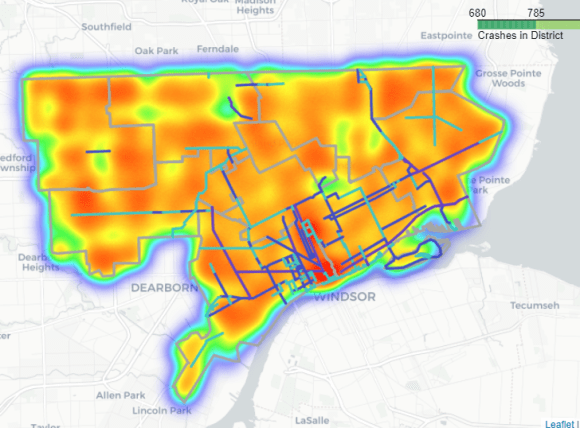
Also on the new website is a bicycle and pedestrian crash analysis — a report, slidedeck, and interactive mapping. This was just produced by a team from the University of Michigan School of Information. The team took state crash data, cleaned it up, and analyzed where the crashes were occuring. From the report:

Our data analysis led important discoveries around the existing safety issues per counsel district, specifically, how bikers are currently being impacted with districts. District 4, according to the data, had the most instances of biker injuries. It’s also worth noting that when a bike lane is present, accidents happen at a frequency a fraction of the time compared to instances of no bike lane with the point of contact being in the roadway.

Thanks to the team for this project and we look using this data to justify great investments that make Detroit streets safer for everyone. 


Other Updates

  • Please join us in welcoming two new board members: Beverly Kindle-Walker and Ryan Myers-Johnson. Beverly is the Executive Director for Friends of the Detroit City Airport CDC, a Legislative Assistance to County Commissioner Tim Killeen, and a board member for the Detroit Eastside Community Collaborative. She’s done a great deal of work on the Eastside, including with the Conner Creek Greenway. Ryan is the Founder and Executive Director for Sidewalk Detroit.  You may have met her if you attended any of the Joe Louis Greenway Framework Planning meetings where she was a project consultant.  She’s also been involved in parks and planning in Northwest Detroit, including Eliza Howell Park. 
  • Detroit Council President Brenda Jones proposed an ordinance last year requiring all bike lane projects to have an additional vote by Council. That ordinance wasn’t feasible, so it was incorporated into an ordinance requiring Community Engagement for planning projects, including bike lanes and streetscapes. We strongly support effective Community Engagement! We’ll continue working with her office and suggesting improvements to the ordinance language so that it gets more Detroiters engaged in deciding how their streets look and who they serve.
  • MoGo Bike Share expansion is underway this week with stations being installed north of Eight Mile. We look forward to seeing those new stations automatically popup on our map. 
  • Make sure you complete your census! Michigan cities receive road funding based on their census populations. State road funding will already be lower in the near future with the reductions in fuel purchases. We don’t need to see it drop further.

Categories
Complete Streets Greenways Newsletter Policy

News from the Trail – March 2019

Streetscape Projects

Many streetscape improvement projects will be under construction this year as part of Detroit’s $80 million Commercial Corridor Program. Per the City, “These streetscape improvements support the City’s neighborhood planning efforts to improve safety and quality of life for Detroit residents. Streetscape improvements might include a variety of amenities including expanded sidewalks, bicycle lanes, improved lighting, plantings, neighborhood branding, and more.” (More on Crain’s Detroit)

Prior emails have encouraged everyone to attend community meetings for Grand River. Those are ongoing with additional information on the city website. As a result of previous meetings and feedback, the preferred design is for a vastly improved pedestrian, bike, and transit experience along this state trunkline while retaining onstreet parking (see below). The city recognizes the need for motorist and bicyclist education with a 2-way cycletrack. Construction is scheduled to begin this year.

There is a community meeting on Tuesday, March 19th from 6-8pm for the Kercheval Avenue Street Design between E. Grand Boulevard and Parker Street. The meeting is at the Solanus Casey Center, 1780 Mt. Elliott Street. (flyer)

Also this month is the East Jefferson Corridor Improvements Community Meeting. It will be held Thursday, March 21st from 6-7:30pm at the Hope Community Church, 14456 E. Jefferson. (flyer)

This Crain’s Detroit Business article covers many of the other exciting projects.


FCA Community Benefits Agreement

The City of Detroit is moving quickly to try landing a new Fiat Chrysler plant near the the existing E. Jefferson plant. There are already bike lanes on all four sides of that facility, including the Conner Creek Greenway and Iron Belle Trail along the St. Jean. Mayor Mike Duggan has proposed vacating St. Jean to gain the needed acreage for the plant. An initial community benefits meeting is this Wednesday, March 13th from 6:30-8pm at the UAW, 2600 Conner Avenue. We’ll be there to ensure the bike lanes and trails remain and propose that they get improved.


Bike Lane Ordinance

Council President Brenda Jones has asked the Law Department to draft an ordinance that requires all new bike lanes to be approved by City Council. We strongly oppose this. As we said recently in public comment before Council, bike lanes are a safety design that improves mobility for bicyclists, pedestrians, scooter users, and those in motorized mobility devices. Current city ordinance gives the Department of Public Works the ability to design safe roads based on national standards. City Council has approved the non-motorized plan that calls for these bike lanes. As one might imagine, there is a wide variety of opinions among city council members as this video from a recent Public Health & Safety Committee meeting shows.

We will keep everyone updated on this proposal and how you can share your thoughts with City Council.


Upcoming Events


Additional Reading & Listening


Ambassador Opportunities

  • MoGo Neighborhood Ambassador applications are due this Friday, March 15th
  • The Detroit Health Department is hiring temporary Safe Routes Ambassadors “to work on safety education with school children and community groups with an emphasis on the recent and upcoming Complete Streets work and Safe Routes to School efforts.”

For the most recent news, follow us on Twitter and Facebook

Categories
Policy

Time to Fix Michigan’s CMAQ Problem

  • Congestion Mitigation and Air Quality (CMAQ) is federal funding that Michigan receives, some of which is allocated to SEMCOG.
  • Michigan has nearly $90 million in unspent CMAQ and the federal government is projected to take back nearly $86 million of it in June 2020.
  • CMAQ is a major funding source for bicycle and trail projects in places like Chicago, but not in Metro Detroit.
  • MDOT and SEMCOG should change their CMAQ formulas to invest in more greener modes of travel such as biking, walking, and public transit.

Haven’t heard of CMAQ? It’s Congestion Mitigation and Air Quality funding in the federal transportation bills since 1991. Some of this funding is controlled by MDOT while a portion is allocated to SEMCOG.

The CMAQ program provides a flexible funding source to State and local governments for transportation projects and programs to help meet the requirements of the Clean Air Act. Funding is available to reduce congestion and improve air quality for areas that do not meet the National Ambient Air Quality Standards for ozone, carbon monoxide, or particulate matter (nonattainment areas) and for former nonattainment areas that are now in compliance (maintenance areas).

Federal Highway Administration (FHWA) web site

The State of Michigan currently has nearly $90 million in unspent CMAQ. Under current law, the federal government is projected to take back nearly $86 million of it in June of 2020.

There are calls for Congress to remove the rescission. That’s fine, but we think the bigger question is why does Michigan have such a large unobligated CMAQ funding balance.

A related issue is MDOT’s and SEMCOG’s antiquated CMAQ project ranking process. It favors traffic signal work since there’s no local match requirement. While these projects may reduce idle times, they don’t take into account how this encourages more driving and negates air quality improvements. They don’t take into account that idling electric, hybrid, and cars with start/stop technology aren’t affecting air quality.

In Chicago, CMAQ largely pays for their bicycle and pedestrian improvements that has shifted travel to greener modes. No CMAQ funding has gone for such improvements through SEMCOG. Zero. (MDOT did fund some Metro I-275 Trail improvements in the past.)

Our bottom line:

  • MDOT should not have such a large unobligated CMAQ balance especially since it’s subject to future rescission.
  • SEMCOG and MDOT should change their CMAQ funding priorities in Southeast Michigan to encourage greener modes of travel that improve air quality.

We certainly would support more CMAQ funding going towards public transit rather than the arbitrary 50% transit/road split that SEMCOG has adopted. 

The Detroit Greenways Coalition is working with elected officials and government staff to address this issue. We want cleaner air and shifting travel to green modes is one guaranteed way to achieve that.

Categories
Greenways Policy

Detroit Bike Clubs in Lansing to support trails

Photo by Pattrick Yockey, Senate Majority Photographer

We worked with the Michigan Trails and Greenways Alliance (MTGA) on a Michigan Senate Resolution in support of Joe Louis, the Joe Louis Greenway and Detroit trails in general. Sponsored by Senator David Knezek, Senate Resolution 115 went before the Senate Committee on Outdoor Recreation and Tourism last week. We thought this was a great opportunity to testify before state legislators and share all that is happening with trails and biking in Detroit.

To do that effectively, we invited Detroit bike club officers to join us. Their organizations and club rides are really helping move things forward in Detroit. We rented a van, bought them lunch, and drove them to Lansing to tell that story.