Categories
Complete Streets Greenways Newsletter Policy Safety & Education

News from the Trail – October 2020

Bike the Vote

Come join us for a group bike ride on Sunday afternoon, October 25th to encourage greater voter participation. We’d love to have a healthy turnout to show that bicyclists are engaged in this year’s election. The weather doesn’t look too bad for late October, either. Masks and social distancing are required!

In addition to supporting this ride, MoGo has a “Roll to the Polls” program that gives riders a free one hour ride to access their polling location or drop off their absentee ballots.  Lisa Nuszkowski, founder and executive director of MoGo says, “Transportation should never be a barrier to voting, and MoGo is proud to join with others in the shared mobility industry to offer free rides on Election Day.”

We continue to endorse Proposal 1 along with more than 30 conservation and environmental groups, including the Michigan Environmental Council, the Michigan Trails and Greenways Alliance, and the Detroit Riverfront Conservancy. The proposal does not change the Trust Fund’s priorities of acquiring and preserving land, which is one reason it’s supported by twelve of the largest land conservancies in Michigan. It also is supported by all of Michigan’s living governors.


Pedestrian Safety Month

We strongly believe that building Complete Streets is the most effective approach for reducing pedestrian (and bicyclist) fatalities. We’ve seen it first hand with improvements to Detroit’s public lighting. Reducing speeding motorists is also a critical issue that can be addressed through Complete Streets, whether it’s more speed humps, lower speed limits, and even bike lanes. 

While the City of Detroit is making new, major investments in speed humps, the speed limit issue is moving more slowly in the state capitol. We discuss these issues and more in our new article, Every Month is Pedestrian Safety Month.


Streets for People

The City of Detroit just launched their Streets for People planning campaign. From the project web page:

The City of Detroit is developing Streets for People, a transportation plan with a singular focus — to make it easier and safer for all Detroiters to move around the city. The plan seeks to knit together diverse neighborhoods, prioritize safety of the most vulnerable road users, and identify clear implementation and design strategies for roadways improvement. Most importantly, it will be rooted in an inclusive planning process that gives a voice to the City’s residents who are most implicated by the transportation system. The plan will be completed over the next two years by the Department of Public Works in partnership with MDOT, SEMCOG, city departments, and partner agencies.

The web page also let’s you sign up for updates and provide some initial thoughts. The plan will be completed in 12 months according to the city’s press release.

Streets for People also has this great introductory video which really frames the pedestrian and bicyclist safety issue to be solved.


Joe Louis Greenway

A second Joe Louis Greenway Design public meeting will be held on October 29th from 6pm to 8pm via Zoom. There is more information about this meeting and how to join it on the city’s Joe Louis Greenway webpage.

If you missed the first public meeting, the presentation is now online and well worth looking over. 

Phase 1 construction continues moving forward. City Council has been asked to approve an MDOT grant request to build a portion of the greenway near Grand River Avenue and Oakman Boulevard. The city has also sold bonds to help with construction as well. They are “aiming to finish Phase I in Fiscal Year 2022.” 


Other Updates

  • Detroit is also updating its Parks and Recreation Plan. They are collecting some initial public input with this online survey. There’s also this interesting article on how COVID could affect this planning. 
  • We’ve been weighing on a number of developments around the city, including the project at the former state fairgrounds involving Amazon. Currently, biking and walking about this area is far from ideal. We submitted comments on how to improve these connections within the development area and with the surrounding neighborhoods, including Ferndale. We also requested bike parking and, if possible, MoGo stations. Our comments seemed to have been addressed by the city and developer.
  • We’ve also been involved in a new proposed warehouse near Conner and Gratiot at the former Cadillac Stamping Plant. Our primary concern was the project’s plan to allow truck traffic to cross the Conner Creek Greenway/Iron Belle Trail at Conner Playfield. It wouldn’t be safe and we expected the trucks would block the greenway as they waited to turn onto Conner. Council member Scott Benson worked with the city and developer to find an alternative truck route that doesn’t cross the greenway.
  • Last month we raised concerns about the city removing unprotected bike lanes during repaving projects, namely the bike lanes on E. Grand Boulevard. DPW followed up and said this was not a city policy. There are proposed plans for adding protected bike lanes on W. Grand Boulevard from Cass to Rosa Parks. We’ll be encouraging the city to continue this design east to replace what was removed.
  • Council President Brenda Jones’ Community Engagement Ordinance passed. It requires many city projects that impact the neighborhoods to have community outreach.The installation of bike lanes was one type of project named in the ordinance. After the E. Grand bike lanes were removed, we proposed that the installation or removal of bike lanes should require community outreach. Council member Benson motioned to add this language to the ordinance and it passed unanamously.
  • The Michigan State Historic Preservation Office launched an online bike tour of Detroit civil rights sites. We were part of the team that helped determine the 17-mile route between the sites. 
  • Lastly, Free Bikes 4 Kids really needs volunteers to help clean and refurbish used kids bicycles to giveaway this year. Please signup for a shift or two and help them get these bikes ready.

Additional Reading

Categories
Complete Streets Policy Safety & Education

Every Month is Pedestrian Safety Month

October is Pedestrian Safety Month where safety groups roll out tepid safety messaging and do a modest amount of short-term traffic enforcement in a handful of Michigan cities. This approach certainly hasn’t led to reduced pedestrian fatalities and serious injuries, which have actually increased over the past decade

What is much more effective than education or enforcement? It’s engineering — building Complete Streets that can self-regulate motorists and reduce speeding 24 hours a day. This is critical since vehicle speed largely determines the degree of injury suffered by pedestrians and bicyclists in crashes. (Vehicle design is a significant determinant as well.)

If there is any doubt that Detroit has speeding problem, just consider Detroiters’ overwhelming demand for speed humps to slow motorists on residential streets. This demand has led Mayor Mike Duggan to shift $11.5 million in road funding to install significantly more speed humps in 2021 — perhaps more than any other major U.S. city.

I’m not sure there’s been any innovation in this city that has been received with more enthusiasm than the speed humps

Mayor Mike Duggan Press Conference, September 16, 2020
YearSpeed humps installedResident requests
201832
20195433,000
20201,2008,000
20214,500 (planned)

Of course speed humps only work on streets were speed limits are 25 MPH or less. Other streets require different Complete Street designs to reduce speeding, e.g. bike lanes, bumps outs, narrower travel lanes, street trees.

Reframing bike lanes as speed humps for bigger roads is invaluable. Bike lanes help reduce speeding and increase safety for everyone, not just bicyclists.

Speed Limits

Another issue we’re working on is how speed limits are set in Michigan.

One major reason the auto industry wrote the “Rules of the Road” in the 1920s was to have higher speed limits and restrict other users, predominantly pedestrians, from using these roads. Higher travel speeds gave motorist a clear advantage over other travel modes and helped sell more cars.

Michigan’s speed limit laws still reflect this history with minimums limits for speed limits and by having the 85th fastest motorist under ideal conditions determine the speed limit — not traffic experts or local governments. This leads to higher speed limits that don’t consider road design, crash history, local land use, and pedestrian and bicyclist use. What’s equally bad is that when roads are reconstructed, they are designed to accomodate the speed limit rather than what is appropriate and safe for the local community.

One local example of this is W. Fort Street near Schaefer. It used to have a 35 MPH speed limit. The Michigan State Police measured the 85th fastest motorist at a bit over 40 MPH, so they raised the speed limit to 45 MPH. They didn’t consider that the neighborhood to the south crossed the road to get to Kemeney Rec Center and park on the north. After the speed limit changed, 8-year-old Brandyn Starks was hit and killed while crossing the street to get to the park.

We’re part of a stakeholder group that’s helping shape current legislation (HB 4733) to provide a modest amount of flexibility in setting speed limits. This change is very much inline with recommendation from the NTSB and many other national organizations. We look forward to providing future updates on this bill.

What about 20 MPH speed limits?

There is a push in many cities around the world to reduce residential speed limits from 25 MPH to 20 MPH. This change is being promoted to help reduce pedestrian and bicyclist fatalities and serious injuries. Recent studies show that lower speed limits do reduce motorist speeds.

However, Michigan law prohibits setting Detroit’s residential speed limits below 25 MPH through January 2024. The Michigan State Police will be doing motorist speed studies on these local roads across the state. We anticipate they will more likely want to raise this 25 MPH minimum rather than lower it by 2024.

Of course, if the legislature takes no action before that time, residential speed limits could be set based on the 85th fastest motorist…

Categories
Newsletter Policy Safety & Education

News from the Trail — May 2020

Staying Healthy, Events Cancelled

We hope everyone is staying safe and healthy during these challenging times. Our thoughts go out all that have lost friends, family, and club members during this pandemic.

We have been updating our COVID-19 page based on information from federal, state and local government agencies. They advise everyone riding, walking, and running to social distance from others, and to wear a mask in places that make social distancing difficult to maintain, eg. RiverWalk.

There are reports of more motorists speeding given fewer motor vehicles on the roads. Please be extra vigilant and walk/ride/run defensively. 

As for events, we obviously could not hold Bike to Work Day this year. We may consider doing something this fall, but it’s too early to make any commitment. We have cancelled our Joe Louis Greenway fundraiser ride scheduled for next month.


New Website

The Stay-at-Home order has provided a good opportunity to completely overhaul our website, which we rolled out this week. All of the web pages have been brought up to date. We’ve also taken the information from our printed bike/trail map and safety brochure and put it on the site. This includes


UMSI Crash Analysis

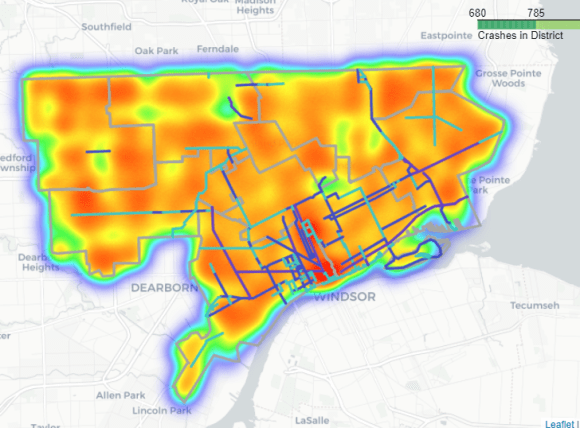
Also on the new website is a bicycle and pedestrian crash analysis — a report, slidedeck, and interactive mapping. This was just produced by a team from the University of Michigan School of Information. The team took state crash data, cleaned it up, and analyzed where the crashes were occuring. From the report:

Our data analysis led important discoveries around the existing safety issues per counsel district, specifically, how bikers are currently being impacted with districts. District 4, according to the data, had the most instances of biker injuries. It’s also worth noting that when a bike lane is present, accidents happen at a frequency a fraction of the time compared to instances of no bike lane with the point of contact being in the roadway.

Thanks to the team for this project and we look using this data to justify great investments that make Detroit streets safer for everyone. 


Other Updates

  • Please join us in welcoming two new board members: Beverly Kindle-Walker and Ryan Myers-Johnson. Beverly is the Executive Director for Friends of the Detroit City Airport CDC, a Legislative Assistance to County Commissioner Tim Killeen, and a board member for the Detroit Eastside Community Collaborative. She’s done a great deal of work on the Eastside, including with the Conner Creek Greenway. Ryan is the Founder and Executive Director for Sidewalk Detroit.  You may have met her if you attended any of the Joe Louis Greenway Framework Planning meetings where she was a project consultant.  She’s also been involved in parks and planning in Northwest Detroit, including Eliza Howell Park. 
  • Detroit Council President Brenda Jones proposed an ordinance last year requiring all bike lane projects to have an additional vote by Council. That ordinance wasn’t feasible, so it was incorporated into an ordinance requiring Community Engagement for planning projects, including bike lanes and streetscapes. We strongly support effective Community Engagement! We’ll continue working with her office and suggesting improvements to the ordinance language so that it gets more Detroiters engaged in deciding how their streets look and who they serve.
  • MoGo Bike Share expansion is underway this week with stations being installed north of Eight Mile. We look forward to seeing those new stations automatically popup on our map. 
  • Make sure you complete your census! Michigan cities receive road funding based on their census populations. State road funding will already be lower in the near future with the reductions in fuel purchases. We don’t need to see it drop further.

Categories
Complete Streets Safety & Education

What are the requirements for a bicycle friendly road?

We received these questions from a Danish Landscape Architect. We thought we’d shared the answers here and get your thoughts as well.

I am working on a project in Detroit and I am interested in understanding how you have decided which roads are bicycle friendly roads and which are not? What are the requirements for a bicycle friendly road?

There are many ways to look at this, but let’s work through some different perspectives:

Infrastructure

The City of Detroit is designing and building roads that are comfortable to use for those from 8 years old to 80 — and for people of all abilities. Whereas initially the City built more traditional bike lanes and bike routes, now they’re looking at biking infrastructure with more separation from moving motor vehicles as a minimum design feature for major roads. This includes separated (or protected) bike lanes and off road trails.

However, Detroit hasn’t added much separation at intersections. We expect to see more of that in future projects.

Many cities are doing this across the U.S., so this answer is not unique. The National Association of City Transportation Officials (NACTO) provides guidance on how to design streets for all users based on the type of road. Detroit is working on a strategic transportation master plan which we expect will incorporate similar principles.

We would add that some of the designs that accommodate slower, less confidant riders aren’t fully embraced by the faster, more confident riders. That’s a trade off in order to get more people riding. Still, the new infrastructure calms motor vehicle traffic, so riding in the roadway becomes a better option for higher speeds or group rides. State law gives bicyclists the right to use most roadways (freeways being an exception.)

Wide streets with little traffic

Detroit’s street network was built for nearly 2 million residents. It built out a freeway network that then pulled motor vehicles from the surface streets. Over a million residents (and countless businesses) left.

What they left behind were wide roads with very little motor vehicle traffic, especially outside of peak travel periods. These roads are very bike friendly to moderately skilled riders without any specific infrastructure treatments.  It’s these conditions that make large group rides like Slow Roll more doable.

The caveat is this doesn’t make the street safe for everyone.

Safety in Numbers

Some roads are bicycle friendly for those riding in a group but not necessarily for those riding solo. We hear this often, especially with female riders. Many feel safe riding busier roads if they’re with a group, but they wouldn’t ride them as individuals.

This reflects the feeling safety that these bike groups share. Everyone is looking out for each other. Everyone is more visible and it’s less likely anyone is going to “mess with” the group. This is likely one reason why Detroit has more bike clubs than any other U.S. city we know of.

What do you think makes a road bicycle friendly?

Categories
Greenways Safety & Education

Healthy biking and walking during the Stay Home order

Governor Gretchen Whitmer announced a Stay at Home order, which includes:

Subject to the exceptions in section 7, all individuals currently living within the State of Michigan are ordered to stay at home or at their place of residence. Subject to the same exceptions, all public and private gatherings of any number of people occurring among persons not part of a single household are prohibited.”

The Exception is:

Individuals may leave their home or place of residence, and travel as necessary: To engage in outdoor activity, including walking, hiking, running, cycling, or any other recreational activity consistent with remaining at least six feet from people from outside the individual’s household.

While announcing the order, Governor Whitmer added, “You can go outside, get that fresh air… just be smart about it.”

UPDATE: In order to comply with this order, the Michigan DNR has announced all campgrounds, overnight lodging facilities, and shelters are closed through April 13th. State parks and recreation areas do remain open.

UPDATE: Kayaking and stand up paddle boarding are also allowed during this time as long as social distancing is practiced.

City of Detroit Statement on Park Usage

The City’s General Services Department (GSD) issued a statement on park usage during the outbreak:

To reduce the spread of COVID-19, the City of Detroit has closed all of its recreation centers through April 5, 2020. Park facilities such as clubhouses, community centers, and public restrooms will also remain closed during this time.

Recent evidence suggests that the COVID-19 virus can live for several days on surfaces such as playgrounds and other “high touch” areas in public spaces. For this reason, please refrain from using playgrounds or other park amenities, and instead focus on taking long walks or bike rides, practicing social distancing of at least 6 feet from other individuals.

Reducing Mental Stress

We have signed on to the National Recreation and Parks Association statement supporting the safe use of parks and open spaces during the COVID-19 outbreak. We agree that we need our parks, trails, sidewalks, and bike pathways more than ever, not just to get around, but to keep our wits.

The Centers for Disease Control and Prevention (CDC) has flagged mental health as a top concern associated with the COVID-19 outbreak. We recognize that social distancing may take a toll on our mental health, especially during high-stress and anxiety-producing global public health emergencies. We also know that parks provide a connection to the outdoors and green space as well as opportunities for physical activity which studies demonstrate reduces stress and improves mental health.

Our local parks, trails and open spaces have always served as places where people can find respite and seek peace and restoration. During this time of uncertainty, these places are needed now more than ever. Our nation’s park and recreation professionals are working hard to maintain these spaces and keep them safe, accessible and benefiting our communities during these challenging times. Let us all do our part to use them in a way that respects each other and public health guidance.

Sad News from Chicago

John LaPlante recently passed from the coronavirus. He was “a staunch advocate for bicycle lanes” in Chicago, but he also played a major role in Detroit.

LaPlante taught a workshop for the Michigan Department of Transportation on how to better design streets for bicyclists and pedestrians. We were able to first bring that workshop to Detroit in 2009. LaPlante brought his extensive engineering knowledge as well as many years of experience implementing it.

The workshop came at a perfect time as we’d recently helped get the City of Detroit’s non-motorized master plan passed by City Council.  The Department of Public Works was tasked with implementing the plan and the workshop helped inform the city’s traffic engineers on how to do so.

While we’d been advocating for bike lanes, it was a challenge. This helped turn things around. LaPlante made this a key milestone in Detroit’s transportation history. Shortly afterwards, the city added many more bike lanes around the city, including the ones on Dexter, Grand Boulevard, Conner, Kercheval, Lafayette, and more.

This news only reinforces the responsibility all of us share in reducing the COVID-19 impact for everyone in the community. Stay healthy.

Categories
Greenways Newsletter Safety & Education

News from the Trail – March 2020

Well that’s not how we expected spring to start! With the weather starting to warm up, we’re all  making plans for group rides, runs, and races. The Coronavirus has put the season on hold. Of course the top priority is for everyone to remain physically and mentally healthy — and that still includes riding, walking, and running while practicing safe social distancing.

The City of Detroit has issued this update on their parks:

To reduce the spread of COVID-19, the City of Detroit has closed all of its recreation centers through April 5, 2020. Park facilities such as clubhouses, community centers, and public restrooms will also remain closed during this time.

Recent evidence suggests that the COVID-19 virus can live for several days on surfaces such as playgrounds and other “high touch” areas in public spaces. For this reason, please refrain from using playgrounds or other park amenities, and instead focus on taking long walks or bike rides, practicing social distancing of at least 6 feet from other individuals.

The Michigan Department of Natural Resources (DNR) also announced the motor vehicles can now access Belle Isle and other state parks without a Recreation Passport during the COVID-19 situation. Note that restroom buildings will are closed. The DNR notes:

We know there’s been a steady stream of “closure” information and messaging about self-isolating to slow the spread of COVID-19. It’s true, we are in uncharted territory, and such steps are critical in protecting Michigan residents from coronavirus risk. Safeguarding mental health is just as important, and spending time outdoors – whether in your backyard, on your balcony or in big, open spaces – can boost mind, body and spirit.


Cancelled and postponed events

The Green Task Force Earth Day Celebration scheduled for April 18th has been cancelled. On a related note, we are taking a larger role in the Detroit City Council’s Green Task Force. We are now co-chairing a new Transportation and Mobility Subcommittee that meets the third Tuesday of each month at 4 PM. Everyone is welcomed to attend.

Our Detroit Bike to Work Day will be pushed back to June. We’re also taking this opportunity to modify the event and broaden its scope to be more than just about getting to work. It’ll be more about biking for transportation, for health, and for sustainability. We look forward to sharing more event updates soon.

We are still planning our Joe Louis Greenway Fundraiser Ride for June 21st. The starting location and route will be updated this year to take advantage of the city’s new greenway routing. Save the date and we’ll let everyone know when the registration opens.


APBP Michigan Webinar Series

The Association of Pedestrian and Bicyclist Planners (APBP) offers monthly webinars on a variety of topics. We find them an invaluable resource for staying on top of the rapidly changing bike/pedestrian environment. Individuals can pay for individual webinar access through the APBP website ($50 members & $85 non-members).

Now, thanks to APBP and the Michigan Chapter, there is a free option. The Detroit Greenways Coalition and SEMCOG are co-hosting the webinars in Detroit at the SEMCOG offices (1001 Woodward Avenue, Suite 1400.

We have a list of the 2020 webinars on our website and APBP has more details on theirs.

Webinars are from 3 pm to 4 pm. More information on each webinar is available on this APBP webpage.

APBP has applied to the AICP for 1.0 Certification Maintenance credits for these webinars.


Thanks, Ashok Patel!

Bike to Work Day 2018 - Ashok Patel, Prasad Nannapaneni, Janet AttarianThere are many City of Detroit staff that are making this city a better place to bike, walk, and run. One of those staff members recently retired: Ashok Patel, who led the Traffic Engineering Division of the Department of Public Works. We first worked with Mr. Patel to help get the Corktown bike lanes approved. He worked with us and MDOT to bring a road design workshop to the city which led to another citywide investment in bike lanes. His contribution to this progress has been significant!

A Detroit City Council Testimonial Resolution also mentions that he “encourages all of the employees in the Traffic Engineering Division to bike.” This has been helpful because it has given the engineers a wider perspective on how road design affects all users.

Congratulations on your retirement, Mr. Patel, and we’ll look forward to seeing you out on the bike.


Other updates

  • The City of Detroit is planting 10,000 trees across the city. If you want one planted in front of your home between the sidewalk and street, call 313 224-6391 or email squalisa@detroitmi.gov. Did you know street trees are one way to reduce speeding vehicles on residential streets? They also help reduce stormwater runoff.
  • The RiverWalk between Cullen Plaza and GM Plaza has reopened. You may recall an errant boat was driven into the RiverWalk last year and caused major damage to the railing. The Detroit Riverfront Conservancy has completed the repair.
  • The Conservancy is also seeking seasonal and trull time support for park operations. The application deadline is March 25th.