Categories
Newsletter

News from the Trail – September 2020

Detroit Bike Tours

Last month we helped support Council members Scott Benson and Roy McCalister Jr. as they hosted three casual bike tours. The purpose of the rides was “to demonstrate to council members, other elected officials, and the city’s, and region’s transportation decision makers how bicycle lanes keep Detroiters safe.” These tours were also an opportunity to talk about traffic calming in the neighborhoods and green stormwater infrastructure (GSI). 

The rides began in Detroit’s Avenue of Fashion on Livernois, traveled north through Ferndale, Pleasant Ridge and back to Detroit. A highlight was having Ferndale Mayor Melanie Piana talk about how the bike lanes have helped attract new business to Livernois while providing a safe family-friendly travel option for residents to get those businesses. 

Other highlights:

  • The Alliance for the Great Lakes held a well-attended pre-tour event to discuss the new Livernois GSI and how stormwater will be managed in the bioswales. 
  • Representatives from Wayne County attended one of the tours and there was a initial discussion on improving Wayne County Roads for biking in Detroit, specifically E. Outer Drive. We are now looking at grant to help move this project forward.

More information on these tours (and more photos) are on our website and on Fox 2 Detroit.


Connecting the Rouge

Speaking of Wayne County, they are also working to extend the Rouge River Gateway Greenway. That trail currently connects Hines Drive to Michigan Avenue (near Andiamo’s). The long term plan is to extend that trail to the Detroit River. A new trail segment behind Greenfield Village is being designed now. 

How can you get involved? They have a short survey online to collect input on your trail use. There’s also a virtual community meeting planned for September 16th at 6pm. Information on how to join the meeting will be posted on the website prior to the 16th.

Meanwhile over in Rouge Park, the City of Detroit has added a two-way cycletrack along Spinozza Drive. They’ve also created this video to explain how it works. The design is very similar to the cycletrack in Palmer Park — which has apparently reduced speeding traffic. Vehicles used to regularly crash into the lightposts along this stretch of road, but none have done so since the cycletrack was installed. 

Also along the Rouge River, trail design work is underway at Rogell Park. The first community meeting is scheduled for September 23rd at 6:30pm. Watch for more forthcoming details on our Facebook and Twitter feeds.


Breaking News

All three of these issues are ongoing. This is what we know currently, so stay tuned for future updates.

  • Bike lane removals — Bike lanes on E. Grand Boulevard were removed during a recent repaving. After some research, we learned the city had a new policy of removing non-separated bike lanes when roads were repaved. This makes no sense to us as it makes roads less safe for all users to no ones benefit. Also, there was no community engagement on this in advance.  We’ve asked the Department of Public Works to rescind this policy. Council member Benson has also gotten involved.
  • Speed limit legislation — State Representative Bradley Slagh (R-Zeeland/Holland) is sponsoring a bill (HB 4733) that would clarify the flexibility in setting speed limits. Rather than strictly set speed limits based on the 85th fasted motorist under ideal road conditions, road agencies could use best engineering/safety practices and take into account road design, land use (e.g. nearby parks), pedestrian and bicyclist activity, crash history, etc. Without this flexibility, many main roads in Detroit could see higher speed limits due to the prevalence of speeding. The original bill removed that flexibility on state and county roads. We opposed that and have proposed alternative language. 
  • I-375 replacement delayed — MDOT asked SEMCOG to pull construction funding from the I-375 Alternatives project and delay it to 2027. We oppose this delay as does the City of Detroit, who is having an ongoing discussion with the state on keeping this project moving forward as planned. It appears to us that the Michigan Avenue (in Corktown) reconstruction funding has jumped ahead of I-375. 

Other Updates

  • Last month, Governor Gretchen Whitmer approved $28 million in Michigan Natural Resources Trust Fund (MNRTF) grants. This included $2.7 million for the Southwest Greenway, $300,000 for a portion of a new 6-mile trail on Belle Isle, and $300,000 for a Perrien Park renovation (at Chene and E. Warren). 
  • We are also a member of the Vote Yes for MI Water, Wildlife & Parks Coalition. Together we are supporting a November ballot proposal that ensures continued grant funding from the MNRTF and strikes a better balance between funding development and acquisition projects. Currently 75% of the grant funding is only for land acquisition (which Detroit typically doesn’t need to do.) If the proposal passes, a minimum of 25% would go towards acquisition and a minimum of 25% for development. 
  • We are also a supporting organization for the national Greenway Stimulus campaign, a call for a $10 billion federal infrastructure investment in regional trails and greenways to spur strong economic recovery and a healthy, equitable future.
  • The Great American Outdoors Act was signed into law last month, providing $900 million in permanent and dedicated annual funding for the Land & Water Conservation Fund (LWCF) and funding to address the backlog of maintenance projects in our national parks and public lands. The Rails-to-Trails Conservancy says, this bill is “considered by many to be the most impactful legislation for parks and the outdoors in decades.” The City of Detroit has a long history of using LWCF grant funding to improve its parks.
  • Speaking of grants, the City of Detroit received a Streets for Pandemic Response & Recovery grant from NACTO. This grant is to help “temporarily close streets near neighborhood schools and parks in Springwells, Warrendale, and northwest Detroit to create outdoor community hubs for young people and other residents. These partners will each program their own spaces tailored to the needs of the specific community where they are based, focusing on creating outdoor learning space, providing childcare, hosting enrichment activities, and creating street art.”
  • A new warehouse could replace the former Cadillac Stamping Plant along the Conner Creek Greenway/Iron Belle Trail, just south of the Coleman A. Young Municipal Airport. We’re involved because we don’t want truck traffic negatively impacting the trail. We also see this as an opportunity to replace an unused parking lot (circled in red) along the greenway with GSI and green buffering. While greenways are often viewed from a recreational standpoint, this trail could be a great option for local employees who chose to bike or walk to work.
  • The City of Detroit’s Joseph Campau resurfacing project includes a two-way cycletrack as part of the Joe Louis Greenway. It originally ran from the City of Hamtramck to the Davison Freeway, but that’s now been extended to McNichols. This project should be completed this year.

Additional Reading & Listening

Categories
Complete Streets

Council member Benson hosts bike tours for cohorts

We are excited to be a part of this effort to bring greater awareness of the value in building bike lanes, traffic calming, and green stormwater infrastructure in Detroit.

[Update: Fox 2 Detroit coverage of the initial tour]

Press Release from the Office of Councilmember Scott Benson

Detroit City Councilmember Scott Benson hosts a series of bike rides in August to promote the City’s bicycle lane safety  

Several elected officials plan to ride along 

FOR IMMEDIATE RELEASE – Detroit City Councilmember Scott Benson is teaming up with Councilmember Roy McCalister Jr. to host a series of bike rides in August. The goal is to demonstrate to council members, other elected officials, and the city’s, and region’s transportation decision makers how bicycle lanes keep Detroiters safe. 

The Councilmen have invited their Detroit council colleagues, Wayne County and Police Commissioners, and local judges to join the ride.  

While Detroit is on track to become one of the nation’s best cities for bicyclists with more than 240 miles of lanes and trails crisscrossing the city, including paths on Belle Isle and the Dequindre Cut, the bike lanes have sparked controversy and created confusion for bicyclists and motorists. Some residents and their representatives simply do not support them. 

Benson, an avid bicyclist, wants to help people understand how bicycle lanes promote Detroiters’ health, provide a safe, inexpensive transportation mode, especially for the one third of Detroiters who do not have access to vehicles, prevent injuries, and save lives.  

The average Detroit cyclist likely is either age 12 or 45, and studies show that Detroit has the highest bicycle fatality rate in Michigan, higher than the cities of Grand Rapids, Ann Arbor, Lansing, and Warren combined. In recent years, data shows that most accidents involved children ages 11-13 and adults ages 44-46, and an estimated 88% of victims are African American. 

“This bike ride is an opportunity to allow elected officials and transportation decision makers to experience bike lanes, traffic calming installations and streetscape design from the perspective of a bicyclist,” Councilmember Scott Benson said.  

“It’s important that we see non-motorized transit as a viable option for all of our residents and people should see what the region is doing to improve the quality of life for our residents. All Detroiters, especially those without cars, deserve access to safe streets.” 

The first bike ride will run from 11 a.m. to 1 p.m. on Friday, August 7 and will begin at the MoGo Detroit bicycle station on Livernois at East Outer Drive. The slow-roll ride will cross 7 Mile Road, head north of 9 Mile Road in Ferndale, and ends with lunch at Kuzzo’s Chicken & Waffles, 19345 Livernois, Detroit. Face masks will be provided. 

MoGo is offering complimentary bike rentals, but participants are welcome to ride their own bicycles. Other rides in the series will run from 10 a.m. to noon on Friday, August 21, 9 to 11 a.m. Tuesday, August 25, with a rain date scheduled for 11 a.m. to 1 p.m. Friday, August 28. 

This ride is being supported by MOGO, Tour de Troit, SEMCOG, the City of Ferndale, City of Pleasant Ridge, Olympia Development, Detroit Geenways Coalition and Alliance for the Great Lakes. 

### 

Scott Benson represents Detroit’s Third District on the Detroit City Council. 

Categories
Newsletter Policy Safety & Education

News from the Trail — May 2020

Staying Healthy, Events Cancelled

We hope everyone is staying safe and healthy during these challenging times. Our thoughts go out all that have lost friends, family, and club members during this pandemic.

We have been updating our COVID-19 page based on information from federal, state and local government agencies. They advise everyone riding, walking, and running to social distance from others, and to wear a mask in places that make social distancing difficult to maintain, eg. RiverWalk.

There are reports of more motorists speeding given fewer motor vehicles on the roads. Please be extra vigilant and walk/ride/run defensively. 

As for events, we obviously could not hold Bike to Work Day this year. We may consider doing something this fall, but it’s too early to make any commitment. We have cancelled our Joe Louis Greenway fundraiser ride scheduled for next month.


New Website

The Stay-at-Home order has provided a good opportunity to completely overhaul our website, which we rolled out this week. All of the web pages have been brought up to date. We’ve also taken the information from our printed bike/trail map and safety brochure and put it on the site. This includes


UMSI Crash Analysis

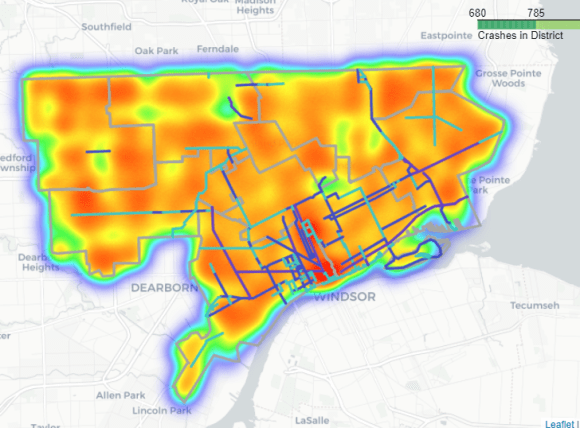
Also on the new website is a bicycle and pedestrian crash analysis — a report, slidedeck, and interactive mapping. This was just produced by a team from the University of Michigan School of Information. The team took state crash data, cleaned it up, and analyzed where the crashes were occuring. From the report:

Our data analysis led important discoveries around the existing safety issues per counsel district, specifically, how bikers are currently being impacted with districts. District 4, according to the data, had the most instances of biker injuries. It’s also worth noting that when a bike lane is present, accidents happen at a frequency a fraction of the time compared to instances of no bike lane with the point of contact being in the roadway.

Thanks to the team for this project and we look using this data to justify great investments that make Detroit streets safer for everyone. 


Other Updates

  • Please join us in welcoming two new board members: Beverly Kindle-Walker and Ryan Myers-Johnson. Beverly is the Executive Director for Friends of the Detroit City Airport CDC, a Legislative Assistance to County Commissioner Tim Killeen, and a board member for the Detroit Eastside Community Collaborative. She’s done a great deal of work on the Eastside, including with the Conner Creek Greenway. Ryan is the Founder and Executive Director for Sidewalk Detroit.  You may have met her if you attended any of the Joe Louis Greenway Framework Planning meetings where she was a project consultant.  She’s also been involved in parks and planning in Northwest Detroit, including Eliza Howell Park. 
  • Detroit Council President Brenda Jones proposed an ordinance last year requiring all bike lane projects to have an additional vote by Council. That ordinance wasn’t feasible, so it was incorporated into an ordinance requiring Community Engagement for planning projects, including bike lanes and streetscapes. We strongly support effective Community Engagement! We’ll continue working with her office and suggesting improvements to the ordinance language so that it gets more Detroiters engaged in deciding how their streets look and who they serve.
  • MoGo Bike Share expansion is underway this week with stations being installed north of Eight Mile. We look forward to seeing those new stations automatically popup on our map. 
  • Make sure you complete your census! Michigan cities receive road funding based on their census populations. State road funding will already be lower in the near future with the reductions in fuel purchases. We don’t need to see it drop further.

Categories
Complete Streets Safety & Education

What are the requirements for a bicycle friendly road?

We received these questions from a Danish Landscape Architect. We thought we’d shared the answers here and get your thoughts as well.

I am working on a project in Detroit and I am interested in understanding how you have decided which roads are bicycle friendly roads and which are not? What are the requirements for a bicycle friendly road?

There are many ways to look at this, but let’s work through some different perspectives:

Infrastructure

The City of Detroit is designing and building roads that are comfortable to use for those from 8 years old to 80 — and for people of all abilities. Whereas initially the City built more traditional bike lanes and bike routes, now they’re looking at biking infrastructure with more separation from moving motor vehicles as a minimum design feature for major roads. This includes separated (or protected) bike lanes and off road trails.

However, Detroit hasn’t added much separation at intersections. We expect to see more of that in future projects.

Many cities are doing this across the U.S., so this answer is not unique. The National Association of City Transportation Officials (NACTO) provides guidance on how to design streets for all users based on the type of road. Detroit is working on a strategic transportation master plan which we expect will incorporate similar principles.

We would add that some of the designs that accommodate slower, less confidant riders aren’t fully embraced by the faster, more confident riders. That’s a trade off in order to get more people riding. Still, the new infrastructure calms motor vehicle traffic, so riding in the roadway becomes a better option for higher speeds or group rides. State law gives bicyclists the right to use most roadways (freeways being an exception.)

Wide streets with little traffic

Detroit’s street network was built for nearly 2 million residents. It built out a freeway network that then pulled motor vehicles from the surface streets. Over a million residents (and countless businesses) left.

What they left behind were wide roads with very little motor vehicle traffic, especially outside of peak travel periods. These roads are very bike friendly to moderately skilled riders without any specific infrastructure treatments.  It’s these conditions that make large group rides like Slow Roll more doable.

The caveat is this doesn’t make the street safe for everyone.

Safety in Numbers

Some roads are bicycle friendly for those riding in a group but not necessarily for those riding solo. We hear this often, especially with female riders. Many feel safe riding busier roads if they’re with a group, but they wouldn’t ride them as individuals.

This reflects the feeling safety that these bike groups share. Everyone is looking out for each other. Everyone is more visible and it’s less likely anyone is going to “mess with” the group. This is likely one reason why Detroit has more bike clubs than any other U.S. city we know of.

What do you think makes a road bicycle friendly?

Categories
Complete Streets

The Community decides on Complete Streets

Photo from Alexis Wiley’s Twitter feed

Mayor Mike Duggan led a community meeting to discuss four streetscape options for W. McNichols just west of Livernois. The first was to rebuild what already existed, a two-lane road with on-street parking on both sides. The second and third options added landscaping and bumpouts. The fourth converted one side of the on-street parking into a two-way bicycle lane.

After a couple hours of community input and discussion, the group voted. It came down to options 3 and 4. While business owners preferred the additional parking in option 3, the city had created an off street parking lot for 88 vehicles — and could add more.

The vote was 39 to 12 in favor of adding the bike lanes. Project construction will begin later this year.

Approaches to Advocacy

Some bicycle and Complete Streets advocates take more adversarial approach (e.g. the War on Cars.). Some bring an intellectual elitism that is willing to belittle local decision making in communities they know little about. We don’t partner with these groups.

We have confidence that Complete Streets can help solve existing community issues like speeding, pedestrian safety, blight removal, access to parks, economic development, etc. The key is to bring all the information to a pragmatic discussion and let the community decide. They may not always support bike lanes and other Complete Streets designs — and advocates may have to live with that.

Certainly there are voices opposing Complete Street designs. While there are valid concerns, most aren’t well support by data. We’ve heard bike lanes emphatically called “the most dangerous thing in Detroit.” We’ve heard bike lanes blamed for causing one persons car crash. (They didn’t. We pulled the police report.) We heard our electronic bike counters on E. Jefferson were wrong because some only saw about three bicyclists in a month. We’ve heard that bike lanes being built for white suburbanites despite the very visible, growing Detroit #bikelife movement.

What have we not heard many say publicly (at least not directly)? That they want to continue driving faster than the speed limit and be able to pass traffic in the curb lane. Bike lanes help curb those unsafe practices. It’s one of the major benefits to bike lanes. They reduce speeding and reduce crashes among everyone: motorists, pedestrians, and bicyclists. Bike lanes are not just for bicyclists’ benefit. They especially improve pedestrian safety in a city with one of the nation’s highest pedestrian fatality rates. They’re like speed humps for major roads.

There will nearly always be opposition any time changes are proposed. There was opposition to the Dequindre Cut before it was built. Once it was a success, the change was embraced, which helped open the door for future greenways in Detroit.

Successful Complete Streets can do the same.

Additional Reading

Categories
Complete Streets Greenways

A Change of Plans: Maurice and Janet

Major changes are coming to the leadership of the Detroit Planning and Development Department (PDD). Planning Director Maurice Cox and Deputy Director Janet Attarian are both stepping down. Both have had a tremendous impact on moving Detroit forward, but especially with parks, greenways, and biking infrastructure. We’ve really enjoyed working closely with them and learning from them.

One especially memorable moment with Maurice occurred shortly after he came to Detroit. He pulled together many of the long time bicycle advocates with city staff and we met in a Mayor’s office. Here he announced that he wanted to make Detroit the best bicycling city in America. There wasn’t much reaction. We were in shock to hear this coming from the city.

It was also Maurice who early on declared that protected bike lanes would be the design minimum for major Detroit streets. He promoted the 20-minute neighborhood idea, where every Detroiter could walk or bike for their non-work errands in under 20 minutes. He expanded the Joe Louis Greenway vision from a mere trail to neighborhood revitalization tool. He was adamant that the Detroit Riverfront should be developed with world class public spaces for Detroiters.

While he and his team achieved much more, we must mention that he also was a regular bike commuter.

Maurice will step down in September and begin his new role as Planning Director for the City of Chicago.

A Bike Infrastructure Rock Star

Bike to Work Day 2018 with Ashok Patel, Prasad Nannapaneni, and Janet Attarian

Losing Janet is equally tough. She came to Detroit via Chicago where she was their Complete Streets Director. She also led the development of hundreds of other projects, including the McDonald’s Bicycle Station, Bloomingdale Trail framework plan, and more.

We used to hustle to bring bike and trail design rock stars to Detroit for workshops, but with Janet, we had one here full-time. She brought a wealth of experience and a pragmatic approach to making safer streets for everyone. She led the design and development of the protected bike lane designs, such as the ones on Cass and E. Jefferson.

She was also instrumental for the framework planning currently underway with the Joe Louis Greenway. At that time, we weren’t certain that was necessary. Now we now it was the right decision. This greenway planning is bringing a much more diverse community voice into the project that strengthens the greenway’s support.

Janet’s last day with the City is July 26th. She’s being coy about where she is headed, but has said she “will not be going far.”

What’s Next?

It remains to be seen who will be the permanent replacements for these positions. We can easily imagine Mayor Mike Duggan seeking equally qualified candidates. In the meantime, there is still a fully-staffed planning department that supports greenways and Complete Streets. Two former members of PDD are now in DPW and GSD as this work has spread between departments.

In short, we’re not worried.